


Tech Brief
Wideband High Power Amplifiers (WHPAs) Product Review
Introduction
RF and microwave technologies are constantly evolving to serve the world’s increasing demands for mobile data in all domains. 5G and 6E are the most visible of the new technologies that require higher bandwidths at multiple and higher frequencies, But there is also a lot of activity in electronic warfare, satellite communications, aviation connectivity, and other technologies, that require higher bandwidths, higher frequencies, higher power levels, and robust, reliable hardware.
Microwave High Power Amplifiers (HPA) are a key component of every RF and microwave system. They are responsible for boosting the RF power level to feed the antenna and deliver RF energy to the air, and they are key contributors to the overall mass, power consumption and heat generation on the final system.
With all these factors in mind, ERZIA has developed a new line of Wideband High Power Amplifiers (WHPA). These new devices serve the changing and flexible needs of RF systems designers, who want to provide more power and bandwidth while optimizing size and power efficiency, using amplifiers with the well known reliability of ERZIA products.
ERZIA’s new models use new, highly efficient DC/DC designs which help to optimize overall power consumption and heat generation. In addition, they are designed using the latest semiconductor technologies, to achieve the smallest possible size. These new amplifiers are COTS, MIL-STD810 qualified, ready for fast deployment, and already included in ERZIA’s production chains under UNE-EN9100 certification. They work at different frequencies for different applications, but they all have in common the wide bandwidth, the high-power level, and a reduced size considering gain and power levels. And they are very efficiency, considering their broad frequency bands.
This product review covers the latest WHPA models comparing performances and benchmarking them with existing solutions.
Product Overview
Table 1 shows that our ERZIA’s new wideband high power amplifiers cover the entire frequency range from 2 GHz to 43 GHz. Although ERZIA already had amplifiers in these frequencies, we designed new ones to provide higher RF power levels and to focus on reducing size as much as possible. The efficiency of the new amplifiers is around 10-15%, which is good considering their wide frequency band and the inclusion of DC/DC converters.
These new designs come from ERZIA’s experience and best practices using the latest tools, materials, and methods available.
| P/N | Frequency | Gain | RF Power | Power consumption (at rated RF Power) | Size (LxWxH) |
|---|---|---|---|---|---|
| ERZ-HPA-0200-0800-36 | 2-8 GHz | 50 dB | 38 dBm (6 W) | 38 W | 105x105x23 mm |
| ERZ-HPA-0200-2000-37 | 2-20 GHz | 35 dB | 37 dBm (5 W) | 50 W | 100x80x21 mm |
| ERZ-HPA-0600-1800-40-E | 6-18 GHz | 45 dB | 40 dBm (10 W) | 85 W | 100x80x21 mm |
| ERZ-HPA-2200-4300-32 | 22-43 GHz | 35 dB | 32 dBm (1.5 W) | 15 W | 50x53x17.5 mm |
| ERZ-HPA-2400-3000-37 | 24-30 GHz | 53 dB | 37 dBm (5 W) | 40 W | 100x100x22 mm |
| ERZ-HPA-3200-3800-40 | 32-40-GHz | 50 dB | 40 dBm (10 W) | 80 W | 100x100x22 mm |
Table 1: Specifications for ERZIA’s new HPAs
Amplifier Design Philosophy
We design our COTS modules to serve a wide range of applications that require reliability, high performance, and efficiency. These modules are versatile and allow us to standardize a combination of components that serve a variety of our customers. This allows us to optimize costs and deliver quickly without jeopardizing performance and reliability.
The following six characteristics are the foundations of our new modules:
- Versatility: Wide band and high power output makes them very versatile, but ERZIA adds extra features to make them even more versatile.
- Robustness: Heavy-duty construction has always been one of ERZIA’s hallmarks, but we have added even more protection to make our modules as robust as possible.
- Reliability: As with robustness, our modules must deliver long term reliability.
- Compactness: All features must be included in the smallest package possible.
- Efficiency: All the previous characteristics must be achieved while using the least possible DC power.
- Performance: The new COTS must perform well overall. Our modules must have a good balance between flatness, matching, bandwidth, and so on.
With all these characteristics, the design of each module was critically addressed while maintaining standardization and production in mind. A review of how this is translated on the amplifiers design is described in the following paragraphs.
Versatility
Due to their bandwidths and output power, customers can use these modules in a wide range of applications. As such, the DC voltage input range must also be able to work with a wide variety of DC power lines that are present in different environments. In addition, some applications require not only the ability to shutdown or to mute the amplifier, but also must be able to do it quickly. The amplifiers also have to be able to operate in continuous wave (CW) or pulsed mode. Consequently, new DC and RF circuits take these considerations into account.
Continuous Wave (CW), Pulsed, and Pulse Modulator
All the amplifiers can operate in both CW and pulsed modes. We have designed a new ultra-fast ON-OFF switching circuitry. This allows you to mute the amplifier (and reduce power consumption to a minimum) with an extremely fast response of 100 ns (typ rise time). This feature allows the amplifier to modulate an input signal or to simply mute the output, which makes it compatible with the most demanding applications.
Figure 1 shows an example of the fast response of the circuit. The green line is the RF output envelope; the yellow line is the ON-OFF command. You can see a rise/fall time of 100-110 ns, with a total of 300 ns (0.3 µs) from the moment the command is activated until it is propagated to the RF output.
Figure 1: Fast Switching Time
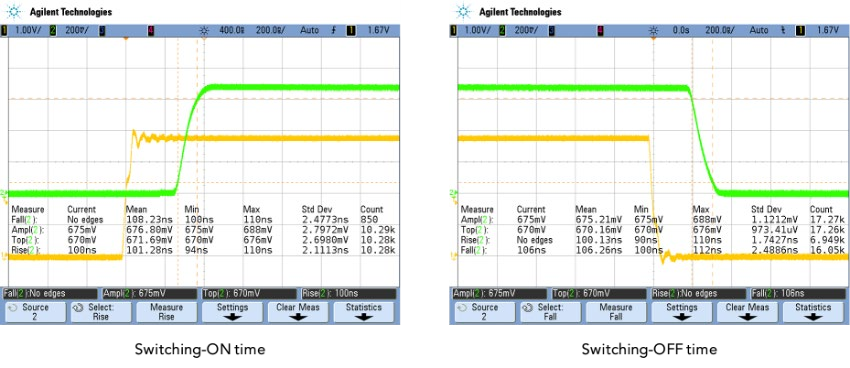
In this case, the amplifier delivers full output power of 10 W with a power consumption of 85 W and consumes only 2.8 W in the mute/stand-by state. Standardizing this characteristic for all amplifiers gives the modules great versatility, which is extremely useful in Radar applications and in telecom transmit and receive stages, or just for saving energy when not in use where its extremely fast re-start is a major advantage.
Wide DC Input Range
All amplifiers allow, by default, an input voltage range of 24 to 32 V, which makes them compatible with a wide number of platforms and standard power buses. The DC/DC component also includes EMI/EMC filters to mitigate noisy power lines. Extended versions have optional DC input ranges of 9 to 32 V.
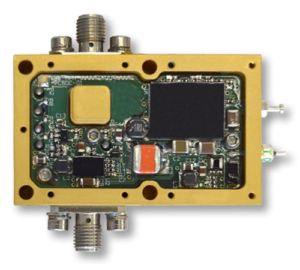
Figure 2 shows an extended DC board, part number ERZ-HPA-2200-4300-32. ERZIA achieves a wide input range in a 23.2 x 43.2 mm package.
Figure 2: Example of an Extended DC Board
Robustness
The amplifiers are robust against shock, acceleration, and environmental hazards. ERZIA designs them this way by default using our knowledge and experience on critical applications. But these new devices include extra protections at the module level.
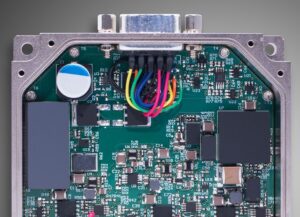
Our DC and control boards include circuitry for current/temperature monitoring, temperature protection, over-voltage protection, and reverse-voltage protection. We implement best practices to boost robustness and reliability. The DC and control board contain all these features in a compact design, which is standardized and minimized.
Figure 3 shows an example of the DC and control board of the amplifier ERZ-HPA-0200-2000-37.
Figure 3: Example of DC & Control Board
Reliability
All ERZIA amplifiers are designed for extreme applications. Our modules are used in facilities located in deserts, the artic, airplanes, vessels, satellites, and so on. All the experience from this vast heritage is applied to the design of these new modules.
Environmental Specs
All modules are rated to MIL-STD-810F as follows:
| Operating Temperature | -40 to +85 ºC | MIL-STD-810F, method 520.2 |
|---|---|---|
| Storage Temperature | -55 to 125 ºC | MIL-STD-810F, method 520.2 |
| Vibration | 8g rms | MIL-STD-810F, method 514.5 |
| Shock | 20g, 11ms, saw-tooth | MIL-STD-810F, method 516.5 |
| Acceleration | 15g | MIL-STD-810F, method 513.5 |
Environmental Stress Screening (ESS)
All ERZIA amplifiers undergo an Environmental Stress Screening as part of the manufacturing process to guarantee long term reliability.
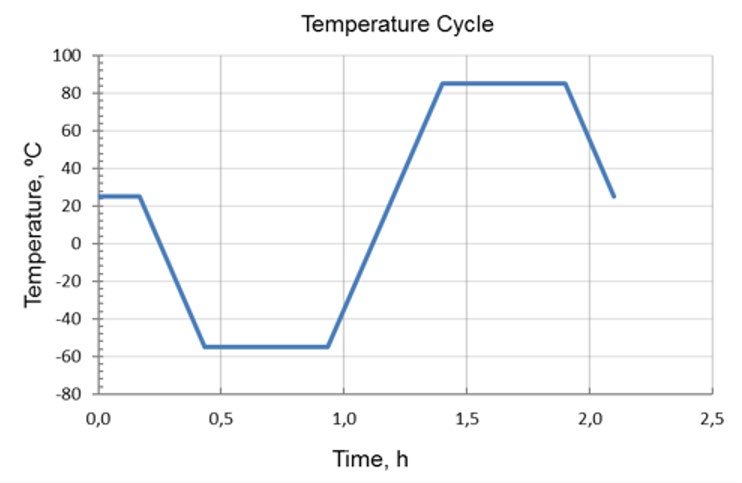
Temperature Cycling: We usually perform 3 cycles (minimum) for ESS. Figure 4 presents an example profile of the cycle.
Figure 4: Temperature Cycle
Compactness
One of the most important qualities of these amplifiers is their reduced size. ERZIA uses the newest RF and DC components to ensure the modules are as compact as possible. We use CAD/CAM tools to optimize size without jeopardizing performance. Radio frequency printed circuit boards (RF PCBs) and the internal mechanics must be properly designed to avoid possible resonance or oscillation within the internal spaces of the amplifier. This ia very sensitive point, especially at high frequencies. Finally, we use the latest GaN and GaAs devices.
Figure 5 shows the RF section of the ERZ-HPA-0600-1800-40-E.
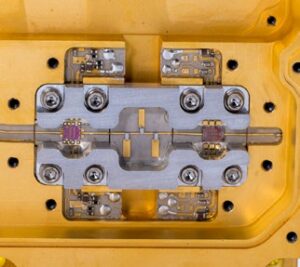
Figure 6 shows the DC section of the ERZ-HPA-0600-1800-40-E. You can see the compact DC/DC and the miniaturized control circuitry that uses the latest technology.

Figure 5: Example of RF Section
Figure 6: Example of DC Section
Efficiency
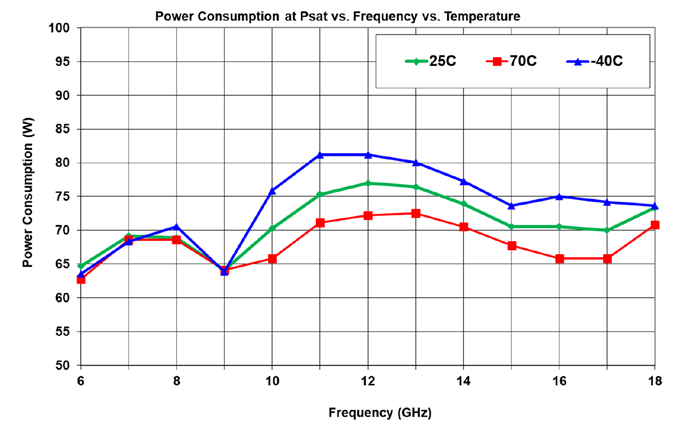
The careful design of the DC/DC converter along with its RF section allows global efficiency for these new amplifiers between 10% at 15% at maximum rated power. Figure 7 presents an example of the power consumption of ERZ-HPA-0600-1800-40-E.
Figure 7: RF Output Power
Performance
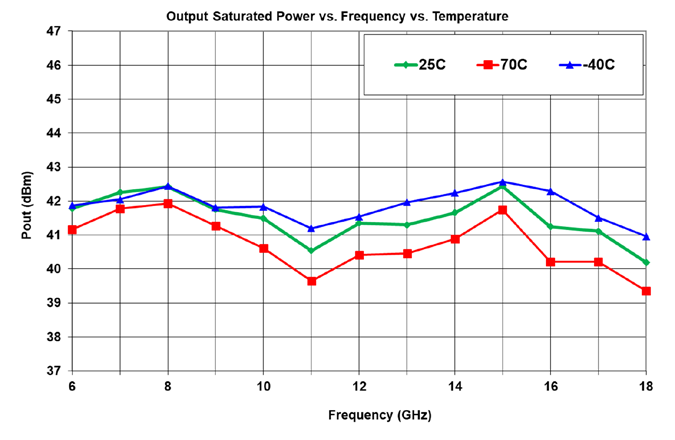
A good RF device must have an excellent overall RF performance. This might sound obvious but it is important to note that during the design stage, we pay special attention to this point to ensure we achieve well-balanced performance. We select the best semiconductors available on the market for the different frequency ranges. Not only do we have to carefully select the last stage to provide the higher output power level but we also have to select the previous stages to have enough back-off so no compression occurs in these stages. We also need to obtain flat gain and low noise because noise can be present when gain is high. Last but not least, we prepare these units to operate at wide temperature ranges so they include internal compensation techniques to make the variability very low.
Figure 8 presents the Psat performance for ERZ-HPA-0600-1800-40-E.
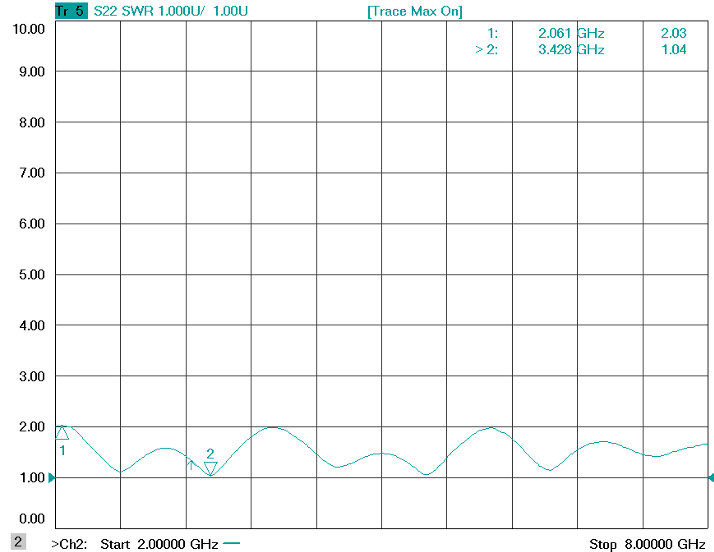
Figures 9 and 10 show the ERZ-HPA-0200-0800-37 input and output matching.
Figure 9: Input Matching
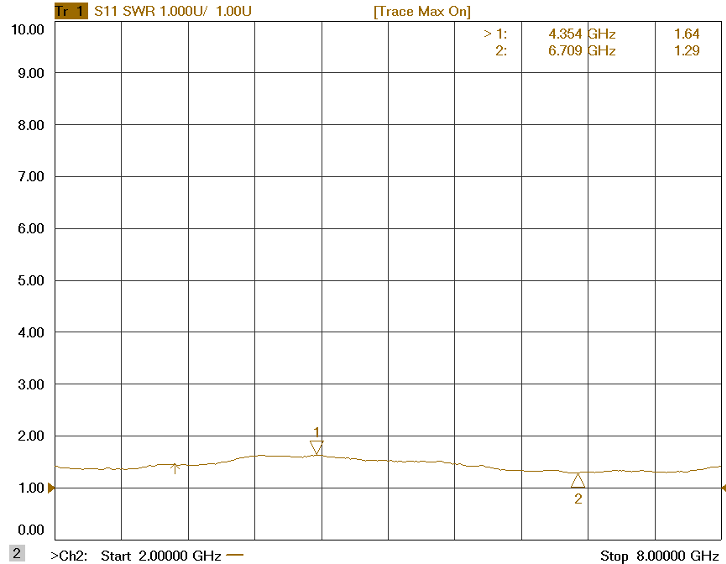
Figure 10: Output Matching
Benchmarking
We compared these six amplifiers with other existing amplifiers on the market. For this comparison, we chose the same output power and bandwidth for every model. It is important to note that we did not find precise matches for some of the models, especially at higher frequency ranges, but we selected units with similar behaviors. It is also relevant that for some models, we used only spec sheets for the comparison, since the models weren’t available.
Figure 12 summarizes the data.
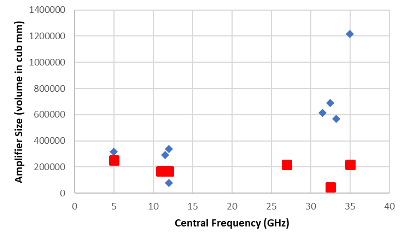
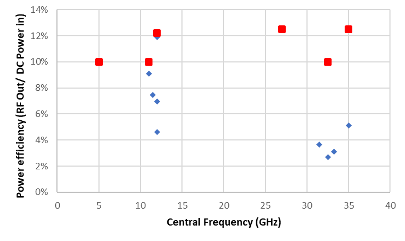
ERZIA amplifiers (red squares) are very similar in size (volume), while a tendency toward higher frequency exists in other amplifiers. We observed similar behavior with power efficiency, where ERZIA WHPAs are on the 10-13% range and other models performance decreases as the frequency increases.
In general, we observed that for similar power levels/bandwidths, ERZIA WHPAs offer optimized power consumption and size over the entire frequency range, with the gap specifically increasing at higher frequencies.
Conclusion
Erzia designs and includes in its catalogue new WHPA state-of-the-art devices with optimized RF power level, efficiency, and size tailored to their operating frequencies. These amplifiers cover frequencies from 2 GHz to 43 GHz with more than 1 W and up to 10 W at very broadband frequencies. ERZIA does not combine power stages to limit the size of the module. We emphasize robustness and reliability as well as versatility, including a new ultra-fast ON/OFF circuit for pulsed operations.
Next Steps
ERZIA monitors cutting edge technologies to be able to design new, reliable, and high-performing amplifiers. Check our www.erzia.com for a list of existing COTS or request a custom design.
Detailed datasheets and measurements of the amplifiers presented in review are available here: