


August 20, 2026
ERZIA’s Take on Radiation-Hardened vs. Radiation-Tolerant: What Space Missions Actually Need
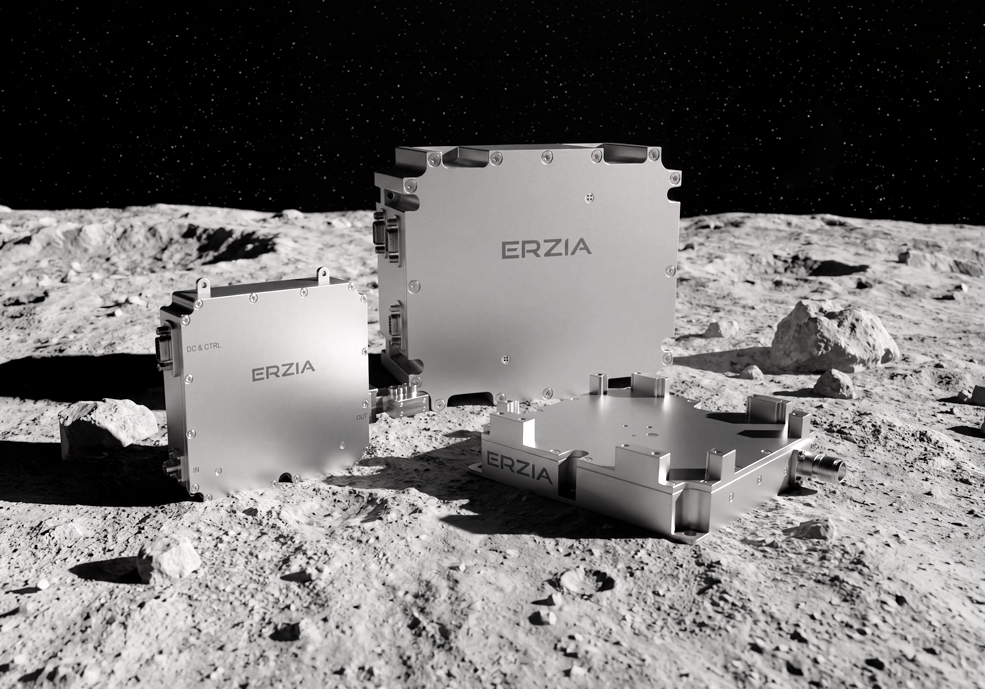
For decades “space-grade electronics” meant one thing: radiation-hardened (rad-hard) components by default. It was the safe answer, and for the flagship missions of that era it was usually the right one.
Then the LEO constellation era arrived and proved, at scale and in orbit, that properly engineered radiation-tolerant hardware is more than valid for those missions.
What is happening now is the interesting part: the same approach is flying beyond LEO, with real experience in MEO, GEO and even deep space.
Here is what the labels actually mean, what changed, and what is operating in orbit right now.
What space radiation does to RF electronics
Three mechanisms matter for RF and microwave hardware:
- Total Ionizing Dose (TID). The cumulative ionizing dose absorbed over the mission, measured in krad(Si). It causes gradual parameter drift: threshold and bias shifts, gain degradation, increased leakage. TID is a function of orbit, mission duration, solar activity and shielding.
- Single Event Effects (SEE). Damage or disruption from individual high-energy particles: transients and upsets (SET/SEU), and — most critically for hardware survival — single event latch-up (SEL), which can be destructive. SEL susceptibility is characterized by a Linear Energy Transfer (LET) threshold, expressed in MeV·cm²/mg.
- Displacement damage. Protons and neutrons displacing atoms in the crystal lattice, degrading minority-carrier devices such as bipolar transistors and optoelectronics over time.
One point often missed: the GaAs and GaN technologies at the heart of modern RF amplifiers are intrinsically far more robust to TID and displacement damage than silicon CMOS — published data for GaN HEMTs commonly shows tolerance from hundreds of krad up to the Mrad range. In a well-designed amplifier module, the radiation-sensitive elements are usually the silicon bias and control circuits, not the RF transistors themselves — and those silicon parts can be selected, screened and protected.
Two Radiation Exposure Labels Defined
Radiation-hardened (Rad-hard) components are designed and manufactured for radiation from the ground up — hardened processes and layouts, typically qualified to 100 krad and beyond (up to 1 Mrad for military/ultra grades), with SEL immunity demonstrated at high LET (commonly >60–100 MeV·cm²/mg). The price of that assurance: unit costs often 10–100x commercial equivalents, long lead times, a small vendor base, and device performance that lags the commercial state of the art.
Radiation-tolerant components are commercial devices whose radiation behaviour is known and managed: characterized for TID (typically 30–50 krad for silicon parts; often far higher for III-V RF devices), lot-screened, derated, and designed into systems with margin, protection circuitry and — where needed — spot shielding. They retain commercial performance, cost and lead times.
There is a third category that gives COTS a bad name: unscreened commercial parts with no radiation data at all. That is not what “radiation-tolerant” means. The difference between hoping a part survives and knowing how it behaves is precisely the engineering work — characterization, screening, derating, margin.
Rad-hard by default: the traditional approach
The rad-hard-first mindset made sense in the era that created it. Missions were few, expensive and expected to last decades; a single satellite was often a national asset with no second chance; and there was little or no radiation data on commercial parts.
With everything riding on one platform, buying the maximum assurance level for every device was rational — whatever it cost in money, lead time and performance. Procurement standards, parts lists and habits were built around that logic, and it became the default answer regardless of what the mission environment actually required.
What LEO constellations proved
The constellation era broke the rad-hard default, not by lowering the bar, but by changing the engineering. A program deploying tens or hundreds of satellites cannot pay rad-hard cost multiples across its bill of materials, nor wait 12–18 months per part. So constellation builders attacked the problem at system level, and the results are now flying:
- Radiation engineering instead of labels. Commercial parts characterized for TID, lot-screened, derated and designed in with margin — knowledge replacing worst-case assumptions.
- Engineering strategy. Latch-up protection, watchdogs, redundancy and graceful degradation across the constellation handle single event effects where it is cheapest: at software and system level.
- Smart shielding. A few millimetres of aluminium dramatically cuts accumulated dose; spot-shielding a sensitive device is often orders of magnitude cheaper than its Mrad-qualified equivalent.
- Robust device technology. The GaN and GaAs MMICs at the core of modern RF chains are inherently radiation-robust — the old assumption that “commercial part = fragile part” simply does not describe III-V hardware.
Thousands of satellites and years of accumulated on-orbit statistics later, the verdict is in: properly engineered radiation-tolerant hardware is more than valid for LEO. What was once a bet is now flight heritage.
…and beyond LEO
The more interesting development is that the same approach is proving itself outside low Earth orbit, with real experience in MEO, GEO and even deep-space missions. That should be less surprising than it sounds, because the radiation environment is set by orbit, duration and shielding — not by how far from Earth a mission travels.
Total ionizing dose is dominated by the trapped-particle belts: an orbit inside the Van Allen belts is among the harshest TID environments there is, while an interplanetary cruise, far from any trapped radiation, can accumulate less dose per year than a satellite in MEO, depending on trajectory and solar activity. “Deep space” does not automatically mean megarad requirements; it means the analysis must be done.
And that is exactly how modern mission planners work: model the environment (SPENVIS, OMERE), compute dose-depth curves behind realistic shielding, compare device LET thresholds against the mission’s particle spectrum, and buy the assurance level each subsystem actually needs — rather than selecting by label.
Space Environment Radiation Requirements and Component Classes
The table below reflects the typical industry categories used to frame this discussion:
| Component Category | Typical Total Ionizing Dose (TID) | SEE/SEL Immunity | Target Mission Profile |
| Generic COTS | Unknown or individually characterized Typical range fom 0 to 30 Krad |
Unknown. | Short LEO missions, small satellite constellations |
| ERZIA NewSpace (Radiation Tolerant COTS) | Extends well beyond the generic COTS baseline: GaN/GaAs RF path plus characterized, screened, derated silicon control circuitry | Latch-up protection and system-level engineering applied per mission | LEO, MEO, GEO and deep-space missions — flight-proven |
| Standard Rad-Hard | 100 krad | >60 to 75 MeV·cm²/mg | Medium Earth Orbit (MEO), standard Geostationary (GEO) communication satellites |
| Military & Ultra Rad-Hard | 300 krad to 1000 krad (1 Mrad) | >100 MeV·cm²/mg | Deep space probes, high-orbit military applications, and outer planetary exploration |
The generic COTS row above reflects a real baseline: a commercial radiation-tolerant part with no further engineering applied to it. That baseline is where most NewSpace hardware starts.
ERZIA’s NewSpace units start from that same baseline and go further. Because the RF path is built on GaN and GaAs devices — technologies intrinsically robust to TID and displacement damage well into the hundreds-of-krad-to-Mrad range — the performance ceiling of a NewSpace amplifier module is set less by the RF transistors and more by how well the surrounding silicon bias and control circuitry is characterized, screened and derated. That module-level engineering is what moves ERZIA’s units into the mission profile the table assigns to Standard Rad-Hard — MEO and GEO. Flight data now extends that further, into deep-space instrumentation.
What actually determines the right choice
- Mission duration and orbit — expected TID behind representative shielding, not worst-case folklore.
- SEL: device LET thresholds versus the mission particle spectrum, and what protection circuitry exists.
- Consequences of a unit failure: single flagship payload or one node in a constellation?
- Mass available for shielding, and where spot shielding is cheaper than part substitution.
- Schedule and budget: what the program can actually wait for and pay for.
- Available radiation data and flight heritage for the specific parts in question.
Flight-proven: the ERZIA NewSpace approach
ERZIA’s NewSpace line applies exactly this engineering logic. New Space Units are engineered to meet the expectative of New Space missions and more. They are designed with radiation tolerance in mind, for both TID and SEE effects, as well as rest of critical space characteristics like vacuum operation or outgassing, while preserving the RF performance and heritage of the standard ERZIA catalogue products. Virtually any unit in ERZIA’s commercial catalogue can be adapted to the NewSpace standard on request.
This is backed by the same quality discipline ERZIA applies across its space-qualified product lines: full traceability from die to finished module, controlled manufacturing processes, and test and inspection protocols carried over from our fully space-qualified builds rather than relaxed for the commercial-parts approach.
The approach is proving itself in orbit. Less than a year after the line was introduced, customers have independently reported ERZIA NewSpace amplifiers operating nominally on their missions — including X-band low-noise amplifiers flying on a deep-space science program and Ka-band high-power amplifiers on a LEO mission.
In the first half of 2026 alone, ERZIA delivered more than 500 New Space amplifier units to programs spanning LEO, MEO, GEO and deep space.
The deep-space example is worth underlining: it is direct, in-mission evidence that the radiation-tolerant approach, engineered properly, is not confined to LEO.
When rad-hard is still the right answer
None of this makes rad-hard obsolete. If the dose-depth analysis shows accumulated TID beyond what characterized commercial parts support even with shielding — long-duration missions deep inside the belts, multi-decade GEO platforms with no redundancy path, nuclear-hardened defense applications, or extreme environments such as the Jovian system — rad-hard or hybrid architectures (rad-hard supervision around radiation-tolerant payloads) remain the correct engineering answer.
ERZIA supports those programs too: fully space-qualified builds have been part of our high-reliability heritage for years.
Choose by analysis, not by label
“Rad-hard” and “rad-tolerant” are shorthand, not requirements. The requirement is that the hardware survives your mission’s environment, for your mission’s duration, with margin — demonstrated by data.
Define the environment, run the analysis, and buy the assurance each subsystem needs. Whether your mission calls for fully space-qualified hardware or radiation-tolerant NewSpace units with growing flight heritage across LEO, MEO, GEO and deep space, ERZIA can help you make — and justify — that call.
Contact us to discuss your mission profile.
Frequently Asked Questions
No — it’s a different way of achieving reliability. Rad-hard components are built from the ground up to resist radiation. Radiation-tolerant components are commercial devices whose radiation behaviour has been characterized, screened and designed around with margin. Both approaches can meet mission reliability targets; the right choice depends on the specific environment, duration and consequence of failure.
Yes, provided the dose-depth analysis supports it. TID depends on orbit, shielding and mission duration — not simply on distance from Earth. Some deep-space trajectories accumulate less dose per year than a MEO orbit. That’s why ERZIA NewSpace hardware is now flying in MEO, GEO and deep-space missions, not just LEO constellations.
Because they are physically different. GaN and GaAs technologies are intrinsically more resistant to total ionizing dose and displacement damage than silicon CMOS, with published tolerance data reaching into the hundreds of krad and beyond. In a well-engineered amplifier, it’s usually the silicon bias and control circuitry — not the RF transistors — that needs the radiation engineering attention.
Run the environment analysis rather than starting from a label: model the mission’s orbit and duration (tools like SPENVIS or OMERE), compute dose-depth curves behind realistic shielding, compare candidate devices’ LET thresholds against the expected particle spectrum, and weigh the consequence of a single unit failure. ERZIA can help walk through this analysis for your specific mission profile.
Read More
Product Catalog(opens in new tab)
NewSpace
NewSpace Products
Contact us today for more information about ERZIA NewSpace products and custom solutions.